McKenzie Rochford
Outline
Explore the ecological and environmental impacts of plant based agriculture in regards to global comparison. Does the western world have different impacts than non-western? There is a unique relationship between humans and plants; and it does in fact differ, globally. Although the problems are different, the solution could be the same: sustainability. If these issues are addressed respectively, but also with the overall goal of sustainability, we may be able to stabilize the food system on earth, even as the population continues to grow.
Global Comparison
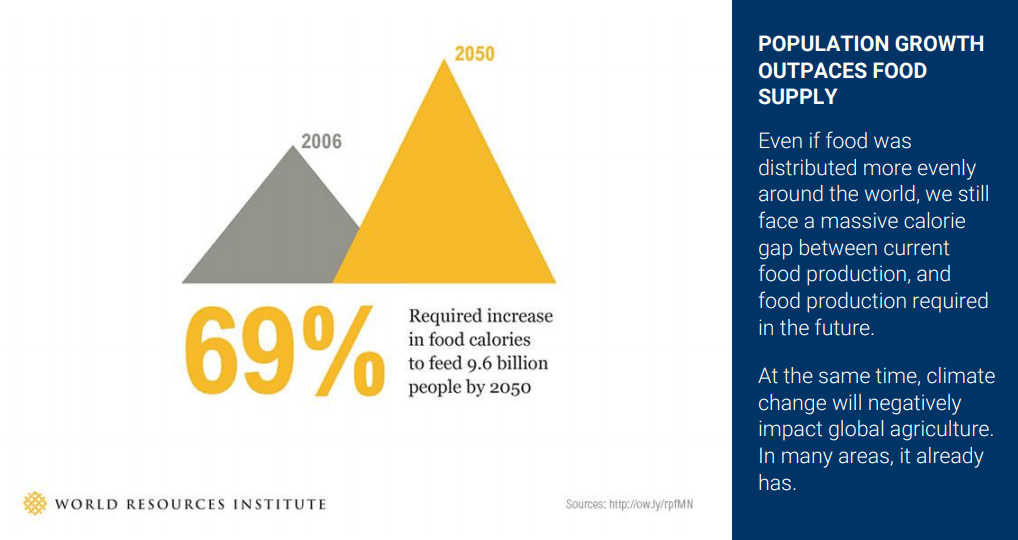
With the population growing exponentially, our planet must find a way to cultivate enough food to keep up with the growth. Food is necessary to life; without it, we will starve. Agriculture can be broken down into arable and pastoral. Arable agriculture involves growing plants, while pastoral involves raising animals. As understood through the other research on this website, plant based agriculture, arable, is more sustainable than pastoral.
Agriculture started independently in different regions around the world roughly 12,000 years ago. It has evolved tremendously, to give us the agriculture we know today:
“The differences between domesticated crops and wild relatives can be attributed to human‐mediated selection (the “artificial selection” described by Darwin). Humans took seeds from wild plants and grew them close to their homes, and the very early farmers observed that some plants had more favorable characteristics than others, such as better‐tasting or more numerous or retained seeds, or were easier to grow, or were more vigorous. Early farmers collected the seeds of the best plants to grow the next year, and this domestication process happened year after year, generation after generation, until the nature of the plant was changed” (Schaal).

The relationship between humans and plants is important to understand. Meat based diets are popular around the world, but it comes with a higher price. According to David and Marcia Pimentel, “Both the meat-based average American diet and the lacto-vegetarian diet require significant quantities of nonrenewable fossil energy to produce. Thus, both food systems are not sustainable in the long term based on heavy fossil energy requirements. However, the meat-based diet requires more energy, land, and water resources than the lacto-vegetarian diet. In this limited sense, the lacto-vegetarian diet is more sustainable than the average American meat-based diet” (Pimentel). Additionally, agriculture is crucial not only to life, but for economic growth. According to the World Bank, one third of the global GDP in 2014 was from agriculture.
The economic relationship regarding agriculture is important because globally, some of the issues differ extremely. Obesity is growing in western societies, while famine is growing in non-western societies. According to the World Bank, “In 2017, one in eight adults–or more than 672 million people—is obese” while also maintaining that “A 2018 report found that the absolute number of hungry and undernourished people increased to nearly 821 million in 2017, from around 804 million in 2016” (World Bank). Identifying the issues regarding agriculture in terms of global comparison is necessary to find respective solutions, globally.
As previously discussed, plant based agriculture is the most environmentally sustainable option. However, plant based agriculture itself can become more sustainable itself. David Tilman explains how we can enforce a “green revolution”:
“Current agricultural practices involve deliberately maintaining ecosystems in a highly simplified, disturbed, and nutrient-rich state. To maximize crop yields, crop plant varieties are carefully selected to match local growing conditions. Limiting factors, especially water, mineral nitrogen, and mineral phosphate, are supplied in excess, and pests are actively controlled. These three features of modern agriculture—control of crops and their genetics, of soil fertility via chemical fertilization and irrigation, and of pests (weeds, insects, and pathogens) via chemical pesticides—are the hallmarks of the green revolution” (Tilman).
The “green revolution” needs to happen if our planet wants to continue to feed a growing population. The problem of obesity in western societies and famine in non-western societies needs to be addressed. Plant based agriculture is the start to evening out the uneven distribution.

Annotated Bibliography
Pimentel, David, and Marcia Pimentel. “Sustainability of Meat-based and Plant-based Diets and the Environment.” The American Journal of Clinical Nutrition 78, no. 3 (September 01, 2003). doi:10.1093/ajcn/78.3.660s.
In this article, David and Marcia Pimentel discuss the unsustainable food system in America. D. Pimentel graduated with a Ph.D. from Cornell University and now is a professor at his alma mater, teaching Agriculture and Life Sciences. Similarly, although recently retired, M. Pimentel was the Senior Lecturer at Cornell University in the division of Nutritional Sciences. Through analyzing the allocation of resources– land, energy, and water, the Pimentel’s compare meat-based diets with plant-based diets. Valid research and credible data are presented to show that plant-based diets are more globally sustainable. The journal entry also dives into the issue of rapid population growth, giving reason to the largest proportion of malnourished people worldwide and concluding why plant-based agriculture is the most globally sustainable agriculture practice.
Schaal, Barbara. “Plants and People: Our Shared History and Future.” Plants, People, Planet 1, no. 1 (2019): 14-19.
In this article, Schaal examines the “plant-human” relationship. Schaal received her doctorate in Biology from Yale, and is not only now a professor at Washington University but she is also the Vice President of the National Academy of Sciences. The plant-human relationship is effected as the world changes. Studying the history of coevolution between hominids and plants helps explain the modern domestication of plants and how they now solely suit our needs. Recognizing this modern relationship gives our global society the responsibility of maintaining it through science and sustainability. Schaal also discusses the global challenges effecting the relationship, explaining why we must protect it and how to approach the future. This article is also extremely relevant and resourceful, being published in January 2019.
Tilman, D. “Global Environmental Impacts of Agricultural Expansion: The Need for Sustainable and Efficient Practices.” Proceedings of the National Academy of Sciences96, no. 11 (May 25, 1999): 5995-6000. doi:10.1073/pnas.96.11.5995.
In this article, Tilman considers the upward trend in global population growth and how agriculture must change to meet those needs. Although this article was written in 1999, its authority is gained through the importance of Tilman’s predictions of the future, 20 years ago, compared with today’s. Although it is hard to predict the future of agriculture, similar problems from 20 years ago still exist today. Through this it can discussed how and where the global practice of agriculture should go. Tilman’s article compares increasing “more of the same” agriculture practices with practices that could decrease impacts of non-agriculture ecosystems around the world.
 Plant Based Agriculture